
- 30 juin 2023
- Envoyé par : LA REDACTION
- Catégorie : International
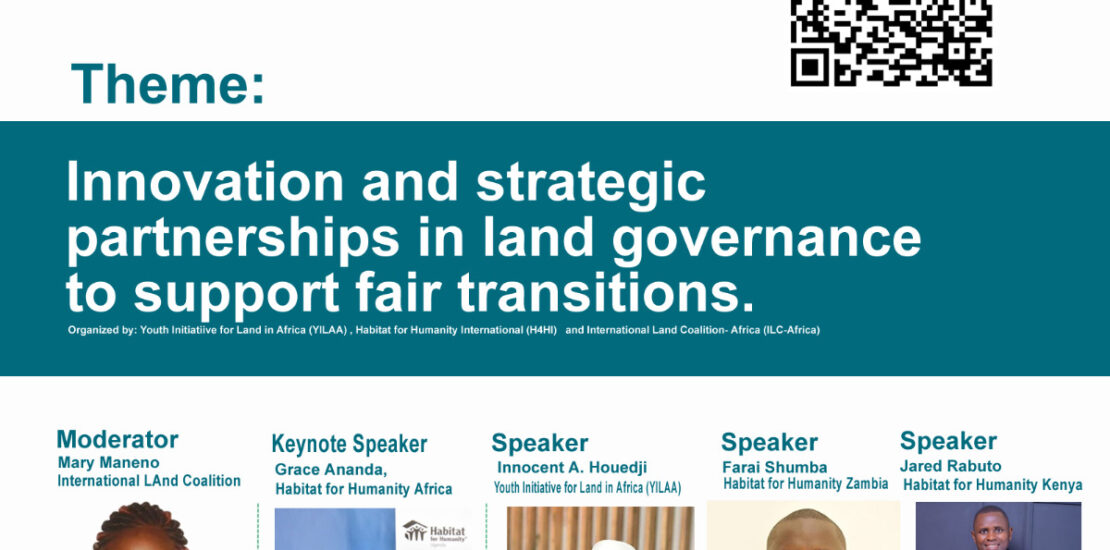
Leveraging on bottom up strategies to amplify collective voices of land tenure
security
There have been unrelenting efforts to change the status quo with renewed advocacy geared towards calling for the recognition and respect of land and natural resource rights. In Africa, activists like the late Wangari Maathai, a Kenyan environmental and political activist who began demonstrating on environmental issues in the 1970s, paved the way for a new generation of advocates championing for protection of land rights and ecological transition. Recognition and respect for tenure rights is critical for responsible land and natural resource governance. It contributes to peaceful co-existence free from exclusion groups in decision making processes, forced evictions, biodiversity loss, landlessness, conflict, human rights violations and loss of livelihoods. While this is the case, the various challenges and opportunities for securing
land rights in practice cannot go unmentioned. This calls for a paradigm shift through strong innovative bottom-up approaches and evidence-based advocacy to deal with land governance whilst applying a fair transition lens. The emergence of youths, media practitioners, land and housing advocates as agents of change and collective action has enabled problematizing the land question from a justice perspective. This session will be dedicated to sharing experiences of social organisations and stakeholders drawn from youth advocates, journalists, land rights defenders, Housing practitioners, women’s rights defenders and indigenous peoples. They will deliberate on land governance, Housing and Human settlement issues while addressing inequalities related to access to and control of land and natural resources. It will further demonstrate how their actions on the ground contribute to the fair transition.
Organizers
Audace Kubwimana (International Land Coalition Africa)
Innocent Antoine HOUEDJI (Youth Initiative for Land in Africa (YILAA))
Grace Ananda & Margaret Mengo (Habitat for Humanity International)
Jeff Wokulira Ssebaggala (Witness Radio)
Registration
Women’s Digital Financial Inclusion: Prospects for Increased Access to Security of Tenure and
Home Improvement. A Case of Makululu Women’s Savings Groups in Kabwe, Zambia
Presenting authors:
Farai Shumba & Mathabo Makuta (Habitat for Humanity Zambia)
Name(s) and affiliation(s) of the authors:
Farai Shumba & Mathabo Makuta (Habitat for Humanity Zambia)
The ability of women to access security of tenure and to build or improve their homes is
inextricably linked to financial inclusion in terms of access and use of financial products and
services. Globally, an estimated 1.4 billion adults do not have access to formal banking or other
financial systems, 54 percent of whom are women . In addition to being financially excluded,
women face phenomenal barriers in accessing or inheriting land and property that often borders
on macro-level challenges such as prohibitive laws as well as discriminatory patriarchal norms. In
Zambia, a paltry 19% of women own land titles post-independence .
The systematic exclusion of low-income earners in accessing affordable financial products to
address their housing needs has seen 70 per cent of Zambia’s urban population residing in
informal settlements where women are disproportionately affected from inadequate security of
tenure and decent housing .
The paper provides a case study on gendered dynamics of digitizing women’s Savings Groups in
Makululu, the biggest informal settlement in Kabwe District. The women have been empowered
with smartphones and are using the DreamSave application to manage financial records, achieve
savings goals, build credit history, and will subsequently be linked to Financial Service Providers to
access tailormade financial services for them to pay for Certificates of Title under the National
Land Titling Program, as well as incrementally improve their homes through the knowledge gained
from the Participatory Approach for Safe Shelter Awareness.
The nexus of digitization of land titling process and access to affordable housing in Makueni
County, Kenya
Presenting authors:
Mark Okundi (Habitat for Humanity Kenya) & Grace Ananda (Habitat for Humanity International)
Name(s) and affiliation(s) of the authors:
Mark Okundi (Habitat for Humanity Kenya) & Grace Ananda (Habitat for Humanity International)
Land issues are becoming increasingly important due to food insecurity, climate change,
unsustainable use of natural resources, and urbanization. Land policies and their implementation
directly impact the rights to food, culture, housing, water, health and mental health, work, and an
adequate standard of living. In Kenya, a person cannot get the necessary approvals for house
construction without sufficient proof of ownership, mostly the land title deed. Habitat for
Humanity works with the UN Housing Rights Programme (UNHRP) to promote efforts to realize
the right to adequate housing. Through evidence-based advocacy project in Makueni County, a
policy review and analysis revealed obstacles that hinder land security of tenure among the low income vulnerable families and women including lack of capacity to handle large transactions,
missing documents, high transaction costs, lack of systems, policies and laws. HFH Kenya through
has supported Makueni County to develop a Land Information Management System (LIMS) to
digitize the land titling processes and increase access to land title deeds. We are working together
with Civil Society Networks and the community to persuade the decision makers to enact policies
that will ensure the digitization of land titling process to enable more people to access the land
titles. Further, linkages to financial institutions to provide financial services basing on land title
deeds as collateral is motivating more people to access fund to construct their own houses. This
calls for fair transition to ensure that even in this process no one is left behind and housing is
made accessible for all.