
- 13 juillet 2023
- Envoyé par : LA REDACTION
- Catégorie : Namibia, Publications
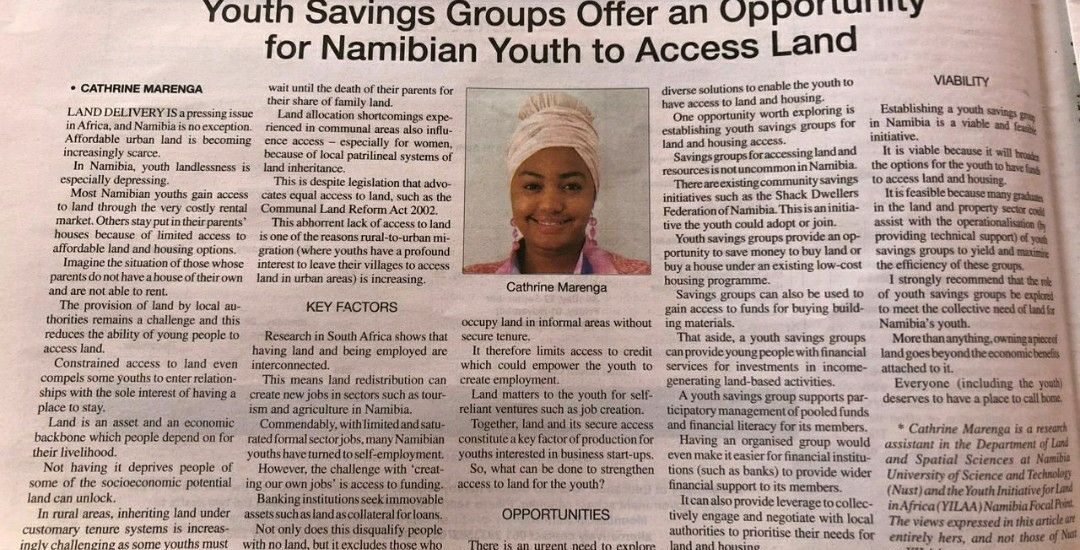
Cathrine Marenga is a research assistant in the Department of Land and Spatial Sciences at the Namibia University of Science and Technology (NUST)and the Youth Initiative for Land in Africa (YILAA) Namibia Focal Point. The views expressed in this article are entirely hers, and not those of NUST or YILAA.
Land delivery is a pressing issue in Africa, and Namibia is no exception. Affordable urban land is becoming increasingly scarce. This is because our population continue to grow, housing prices keep rising, and the stock stays in short supply. The inability of most Namibians to access land is evident in the growth of informal settlements in urban areas. The reality looks at us in the face daily. The provision of land by the local authorities remains a challenge and this reduces the ability of young people to access land. Most Namibian youths get access to land through the very costly rental market. There are many others who have stayed put in the parents’ houses due to the limited access to acquire affordable land and housing options. Imagine the situation of those youth whose parents do not have a house of their own and are not able to rent. Youth landlessness in Namibia has become quite depressing. Constrained access to land even compels some youth to enter relationships with the sole interest of having a place to stay.
Land and Youth
Land is an asset and an economic backbone which people depend on for their livelihood. Not having deprives people of some of the socioeconomic potentials having land can unlock. In rural areas, acquiring land through inheritance under customary tenure systems is increasingly challenging as some youth must wait long till the death of their parents to inherit their share of family land. The land allocation shortcomings experienced in communal areas also influences access, especially for women due to local patrilineal systems of land inheritance. This is despite the legislations in place that advocate for equal access to land, such as the Communal Land Reform Act 2002. This abhorrent lack of access to land is one of the reasons rural-to-urban migration (a situation where youth have profound interest to leave their villages to access land in urban areas) is on the increase.
There is research evidence that having land and being employed are interconnected in South Africa. This means that land redistribution can create new jobs in sectors such as tourism and agriculture in Namibia. Commendably, with limited and saturated formal sector jobs, the Namibian youth have turned to self-employment. However, the challenge with ‘creating our own jobs’ is access to funding. Banking institutions seek immovable assets such as land as collateral for the assessment and issuance of loans. Not only does this condition disqualify people with no land, but it also excludes those who occupy land in informal areas without secure tenure. It, therefore, limits access to credit which could empower the youth to create employment. So, land matters to the youth for self-reliant ventures such as job creation. Together, land and its secure access, constitute a key factor of production for our youths interested in business start-ups. So, what should be done to strengthen youth access to land in Namibia?
Establishing Youth Savings
There is an urgent need to explore diverse solutions to enable the youth to have access to land and housing. One opportunity worth exploring is the establishment of youth savings groups for land and housing access. Savings groups for accessing land and resources is not uncommon in Namibia. There are existing community savings initiatives such as that of the Shack Dwellers Federation of Namibia. This is an initiative the youth could adopt or join. Youth savings groups provide an opportunity to save up money to buy a block of land or purchase a house under an existing low-cost housing programme. Savings groups can also be used to gain access to fund for buying building materials or other land resources. Buying land or house aside, a youth Savings groups can provide young people with financial services for investments in income-generating land-based activities. A youth savings group supports participatory management of pooled funds and financial literacy for its members. Having an organised youth savings group would even make it easier for financial institutions (such as banks) to provide wider financial support to its members. It can also give the youth the leverage to collectively engage and negotiate with local authorities to prioritise their needs for land and housing. Establishing a youth savings group in Namibia is a viable and feasible initiative. It is viable because it will broaden the options for the youth to have fund to access land and housing. It is feasible because many graduates in the land and property sector could assist with the operationalization (by providing technical support) of youth savings groups to yield and maximize the efficiency of these groups.
I strongly recommend that the role of youth savings groups be explored to meet the collective need of land for Namibian youth. More than anything, owning a piece of land goes beyond the economic benefits attached to it. After all, everyone (including the youth) deserves to have a place to call home.